“Something is happening here, but you don’t know what it is
Do you, Mr Jones?”
~ Bob Dylan, Ballad of a Thin Man
Many years ago I invited a friend to a screening at a local indie film showcase. It was a documentary called “Mrs. Fang” about a Chinese woman dying of Alzheimer’s disease. We gradually realised, to our disappointment, that the film was literally about what it was about: an old woman dying—and little else. There was no narration. Most of the scenes were long plodding shots of Mrs. Fang lying in bed, silent, mostly unconscious. Sometimes there were visitors, who would stand and chatter above this slowly dying woman.
My friend complained afterwards, lamenting spending money on our tickets. Although I shared the sentiment, I couldn’t help but feel there was something else going on.
Over the next few days I reflected on it a little more and concluded that: yes, the film was indeed boring. But perhaps you’re supposed to be bored. How else are you supposed to feel watching someone die for two hours? The truth is, death is usually more romantic in the abstract. In real life, people tend to die slowly and in undignified ways. The physical reality of death is mundane and messy, and as sterile as the hospital it usually happens in. Watching someone die in a movie is supposed to be heartfelt and poignant. Watching someone die in real life is… well, boring.
This made me think about why the medium of film is so conducive to feelings of boredom and restlessness. You can be profoundly uncomfortable watching a five minute scene of someone walking through a field. But walk through that same field yourself for five minutes and you barely notice. Interestingly, this time-dilatory effect also happens when we are in pain. Sticking your finger in a pot of boiling water can make 10 seconds feel like an eternity. Does this reflect a phenomenological common denominator?
We generally associate cinema with entertainment. Therefore, when this expectation is subverted we are catapulted into the absence of the enjoyment we were anticipating. It elicits a kind of existential irritation. We suddenly and unexpectedly find ourselves having to confront ‘lack’ (in the Lacanian sense): an encounter with unfulfilled desire that lies at core of our being.
In film, this feeling is most often triggered by the ‘long take’—a shot that lasts longer than conventional editing pacing; it’s a sort of a staple in avant-garde cinema. Use of this cinematic technique signals that a film is ‘serious’, but also conveys an element of pretension if done poorly.
Arguably, the master of the long take is the iconic Soviet director, Andrei Tarkovsky. If you’ve ever watched anything by Tarkovsky, you’ll have noted his predilection for slowness, and like myself, may have felt more than the occasional tinge of impatience. Tarkovsky is famous for his long takes, which are often met with polarised reactions (his average shots last longer than a minute, as opposed to commonplace editing that use shots of 2-3 seconds each). To some, Tarkovsky’s work is the epitome of visual poetry, to others, the embodiment of dull pretentiousness.
Personally, I’d long avoided Tarkovsky, finding him imposing and somewhat impenetrable. But, while recovering from a recent heartbreak, I decided to give him a second chance and dove into a large chunk of his oeuvre. This time, I wasn’t watching to be entertained, but rather, to be transported elsewhere. I wanted a more of a spiritual distraction. If you like, call it a kind of existential ‘self-harm’—to distract from overwhelming pain of a different origin. I don’t mean to say Tarkovsky wishes to inflict discomfort on his audience, but I think he finds it instrumental. There seems to be a conscious awareness in his work of how a shot affects its viewer. In forcing the gaze to linger on a scene longer than is comfortable, Tarkovsky fosters engagement beyond what is expected of a passive audience.
Liberated from the need to be entertained, I found it easier to surrender to Tarkovsky’s meditative sequences. I was transfixed by Mirror—the sparse dialogue and droning soundscapes enveloped me in scenes of impressionist beauty.

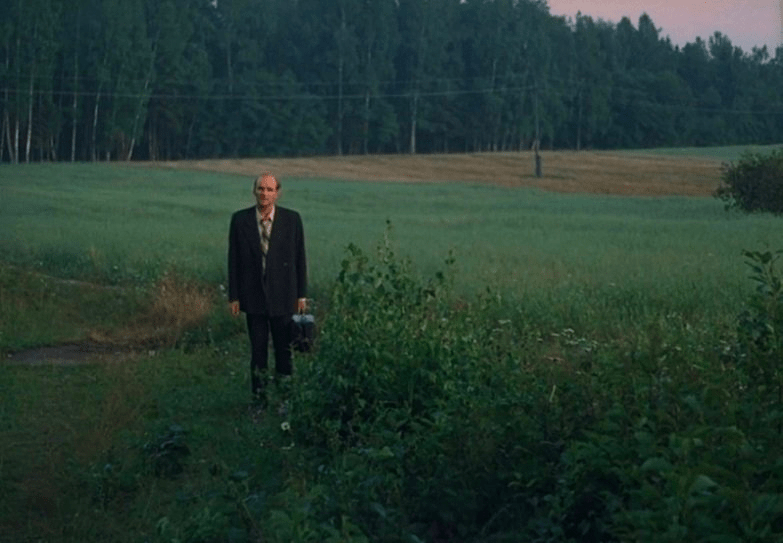
Similarly, in Solaris, I acquiesced to this dreamy study of love’s irrationality while hypnotized by the melancholic synthesisers in Eduard Artemyev’s soundtrack that features Bach’s hauntingly moving ‘Ich ruf zu dir, Herr Jesu Christ’. Emotional pain granted me a heightened sensitivity and, importantly, the patience to engage with and bask in the beauty of each cinematic moment.

“If you look for a meaning, you’ll miss everything that happens”
~ Andrei Tarkovsky
These are sentiments that would have previously remained under-appreciated—on account of ‘nothing interesting happening’. But in my heartbroken state, I was much more open to emotionally connecting with subtle themes and consciousness beyond superficial narrative and appearances. Unfortunately, in our digital age of short attention spans, it’s difficult to carve out time for introspection and spirituality. Discomfort can be far too easily dispelled, entertainment is always just a tap or a swipe away. When boredom has become an intolerable imposition, how do we cultivate the patience needed to engage with the divine (or at the very least, Tarkovsky)?
As I discovered, one solution is to get your heartbroken—but this is likely not the most sustainable spiritual practice. I suppose more mindfulness is probably helpful; paying closer attention to what art or life presents to us; not expecting to be entertained when a woman is dying in front of us; and considering what lies behind our desire for immediate gratification. Let’s ask ourselves: How do we feel when ‘nothing’ is happening? Is ‘nothing’ really happening? Maybe something is happening, but do we know what it is?
 patrick 林香麟