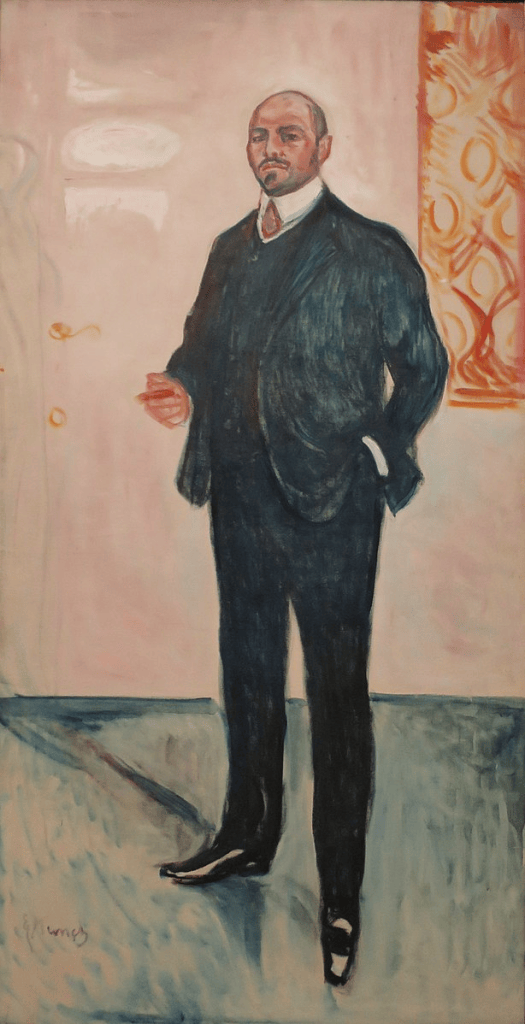
“An awful character isn’t he?”, remarked Walter Rathenau upon seeing his likeness portrayed by Edvard Munch: “That’s what you get for having your portrait done by a great artist—you look more like yourself than you really are”.
Rathenau was a German-Jewish industrialist, statesman and writer. He rose to prominence through entrepreneurship in electrical supply-chain management, and was eventually tapped as foreign minister of the burgeoning Weimar Republic. With a penchant for the arts, Rathenau wrote poetry and often spent time in musical salons organised by his close friend, Lili, a socialite whose guests included Richard Strauss. Rathenau also struck up a friendship with Einstein and the two were known to play Schumann sonatas at dinner parties. Not too dissimilar to today’s neo-industrialists. Rathenau’s artistic predilections juxtaposed against his intense materialistic ambitions strike an interesting chord. Lili would often criticise Rathenau for his industrialist tendencies. He, in turn, understood his industrial and artistic pursuits as expressions of the same creative impulse—and his gifts as an obligation to pursue them. In a letter to Lili, he writes: “There is something half-wrong in receiving gifts, even from Nature.”
I think a lot about what makes people ‘tick’, and in particular, the motivations of the prolific and ‘creative souls’ of history. For some reason these days there’s a kind of faux-modesty expected when the topic of natural ability arises. When asked about talent, generational minds like Tao and Feynman often skirt around their own brilliance by attesting that hard work or ‘passion’ is more important than anything innate or hardwired. The unspoken assumption being that a penchant for “hard work” could be acquired as simply as slipping on a new pair of shoes. I often wonder: do these individuals know how ‘special’ they really are? In immodest early 1900s fashion, Rathenau describes this candidly in his book, “Mechanisms of the Mind”:
It is true that my nature is polyphonic. The melody rises like a treble above the other parts, but it is very seldom unaccompanied. And in the bass and tenor other sounds are heard, sometimes harmonizing, sometimes in utter discord with the song. I know incomparably better men, in fact great men, in whose every word and thought I detect the same phenomenon; in this I find I do not stand alone. Indeed, it sometimes seems as if it were this very strength or weakness which like a shell re-echoes, though faintly, the rush and roar of the whole world. Meanwhile the pure flute notes of more simple natures seem to me monotonous, charming and rather dull.
Now, this is why people are mistaken in me, because in this medley of voices they fail to recognize a melody. But I recognize one, and know that it is there, and that it controls all the rest.
Rimbaud has a similar line I’m fond of: “I wave the baton; the symphony murmurs from its depths or comes leaping onto the stage”. Perhaps this is the source of talent. A sort of awareness of one’s taste is necessary to cultivate innate artistic agency. What can help us find ‘melody’ amidst the ‘murmuring symphony’?
I recently watched this interview with Rich Hinman, a guitarist and faculty at Berklee. He talked about what about his music had remained unchanged since his late teens. He answered, ‘taste’. He always felt he knew ‘what he thought was good’. Which, he continues, ultimately boiled down to knowing what you like and don’t like. There is a paradox in art, that traverses the gulf that separates objectivity and quality. To have a sense for what is ‘good’ first you must have a sense for what you like. As an aside, this, ultimately is why I think ‘AI art’ is a non-sequitur. Perhaps the kernel of human creativity is being drawn to a particular art or artform, to be given the gift of discernment.
At first glance, it seems somehow wrong or premature to then conclude that whatever you ‘like’ is automatically ‘good’. But of course, ‘taste’ requires more than just exposure. It needs active interrogation. It’s focused listening, watching or reading. To play with the material, and ask what in it sparks joy in you and to throw away the rest. But remember to forget all about it as soon as you have a kid or three.
Sources:
https://archive.schillerinstitute.com/educ/hist/2012/rathenau.html
n.b.
The title of this piece was orignally ‘Obligation’, but it has turned into more of an essay about talent. I’ll return later to the relationship of talent and obligation and probably write something related to an incredible biography I read recently of Wittgenestein (Ludwig Wittgenstein: The Duty of Genius by Ray Monk).

